Healing: All damage on your board (heroes, creatures, buildings) heals fully when your turn ends.
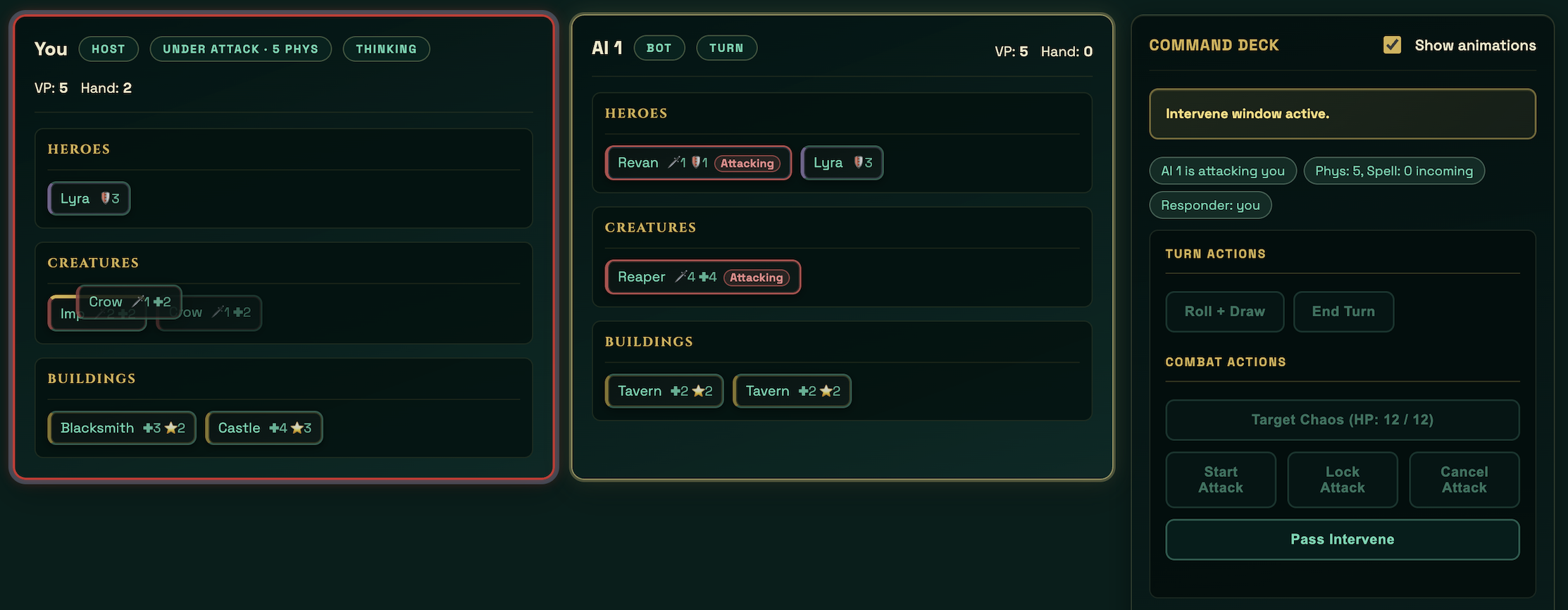
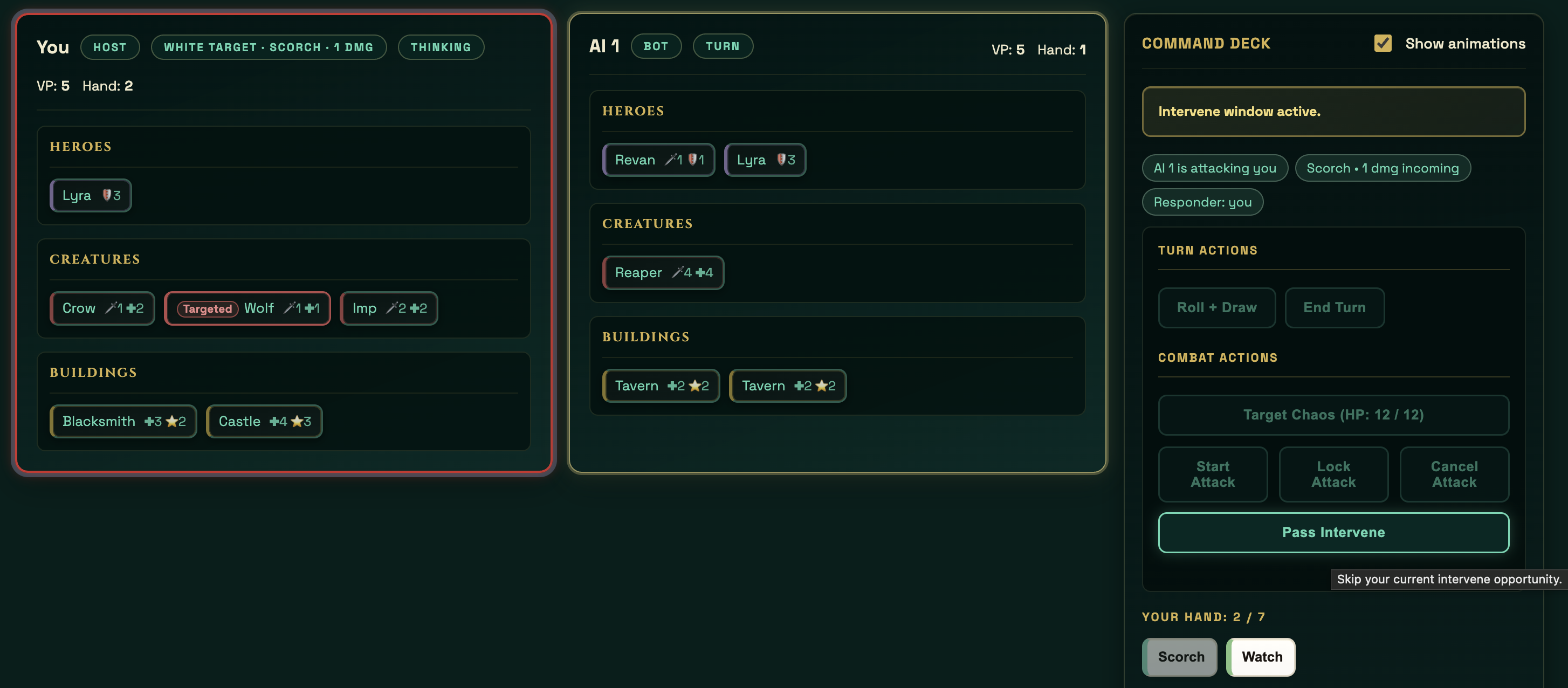
Intervene: When attacked, defender responds first, then others, attacker last.
Tip: Turn on Tutorials in the room settings for first-time coaching popups.
How to Win — Victory Points Explained
There are three ways to win. The main path is reaching 8 Victory Points (VP) and holding them.
1. The 8 VP Path (most common)
You win when you have 8 or more VP at the start of your own turn — in other words, you must hold 8+ VP through a full round of opponents. Reaching 8 mid-turn is not enough; opponents get a full round to knock you back below 8 before the win locks in. This is why VP doesn’t just “end the game” the moment you hit 8.
2. Where VP comes from
Your VP total is calculated live, every turn from what’s currently on your board. It is not banked or saved — if a building dies or gets stolen, your VP drops.
Building stars (⭐): Every non-stunned building you control gives its printed star value. Example: Tavern (2⭐) + Palace (3⭐) = 5 VP.
Matching pairs: For every 2 copies of the same card on your board (Heroes, Creatures, or Buildings), you score +1 VP. Counted per unique name. Example: 2 Wolves + 2 Taron = 2 VP from pairs. 3 Wolves = 1 VP (the unpaired Wolf scores nothing).
Secret Ruins bonus: Playing a Secret Ruins from your hand grants +2 VP for one full round, then it discards. A great way to push from 6 to 8.
Quick formula: VP = (printed star total of your unstunned buildings) + (1 per matching pair across heroes/creatures/buildings) + (any active Secret Ruins).
3. How to lose VP
Anything that removes a card from your board can drop your VP, sometimes drastically. Watch for:
Buildings destroyed by physical attacks (heroes & creatures hit buildings after burning through your front line).
Buildings stunned — their stars are turned off until end of your next turn.
Seize (Bonus) takes a building straight off your board into the opponent’s.
Betrayal flips one of your heroes or creatures to the opponent — breaking your pairs and giving them potential pairs.
Steal & chaos effects can disrupt your pile silently.
4. The two instant-win shortcuts
3 Sheds: Get three Shed buildings on your board at the same time. Sheds are weak (1 HP, 1⭐ each) so opponents will try to break them, but if you ever line up three at once you win immediately.
7 Chaos cards: Attack the Chaos pile (Target Chaos) and meet the rising HP threshold (2 → 4 → 6 → 8 → 10 → 12) to claim a Chaos reward each time. Collect 7 and you win immediately.
5. Reading your VP in the UI
Your VP number is shown in your player panel header (VP: N). When it crosses 8 your panel pulses to flag the hold-through-the-round window. The activity feed announces VP changes so you can see exactly what moved the number and why.
Strategy tip: The 8 VP path rewards diversification (a couple of buildings + a couple of pairs) so a single Seize or Betrayal can’t one-shot your score. Going all-in on one giant building is fragile.
Walkthrough: Your First Turn
Each step below shows what to click and what happens.
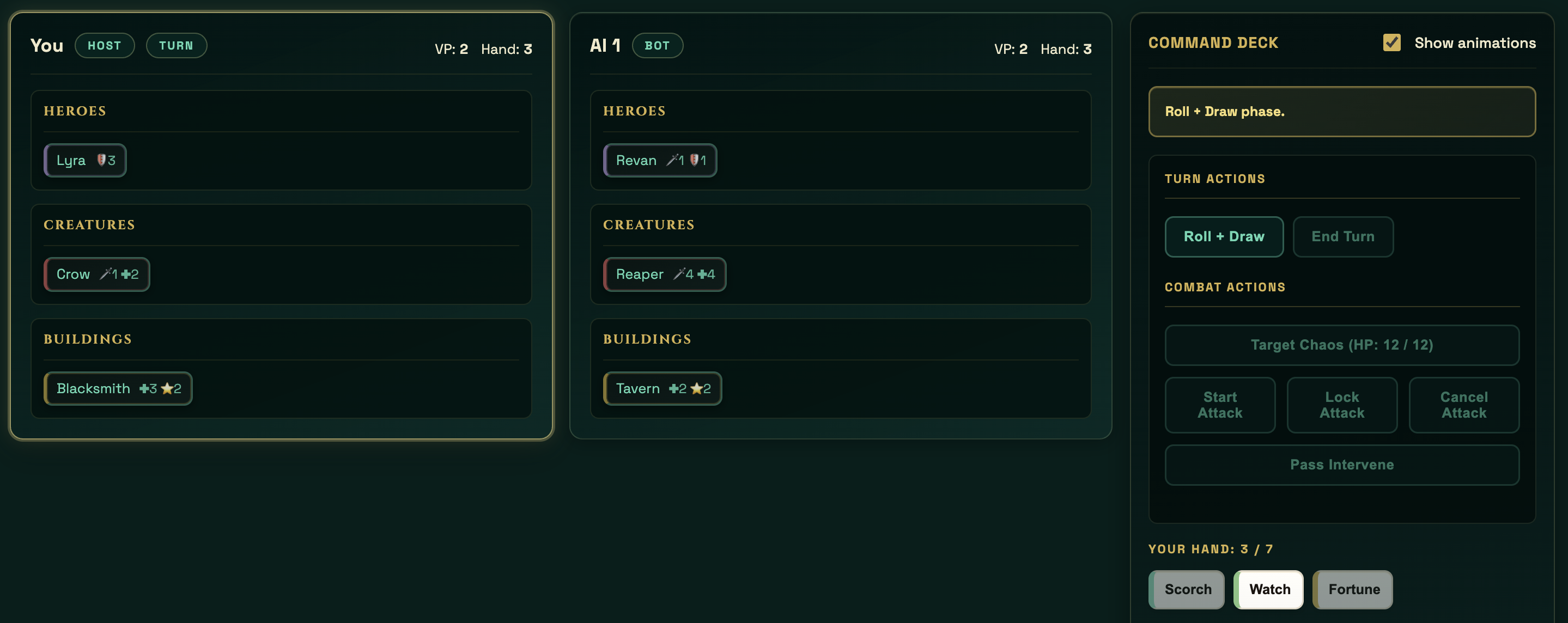
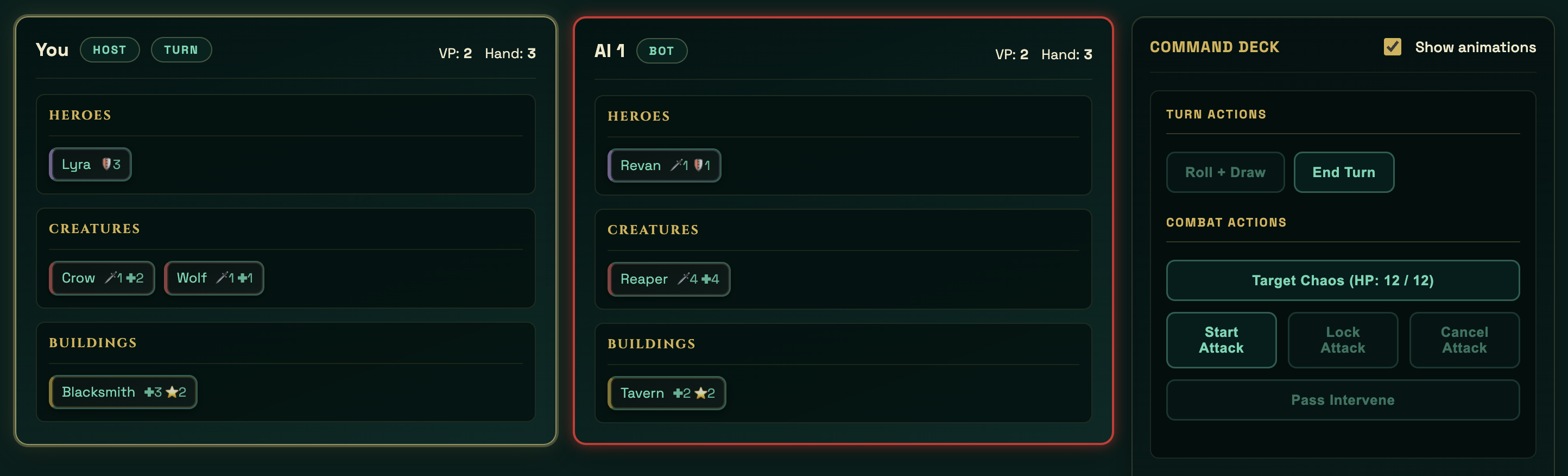
1. Get oriented. Your panel is highlighted. The top shows whose turn it is and the current phase. Your hand sits at the bottom; everyone else's hand is hidden.
See their hand: Hover over another player's "Hand" on their board to see what types of cards they have.
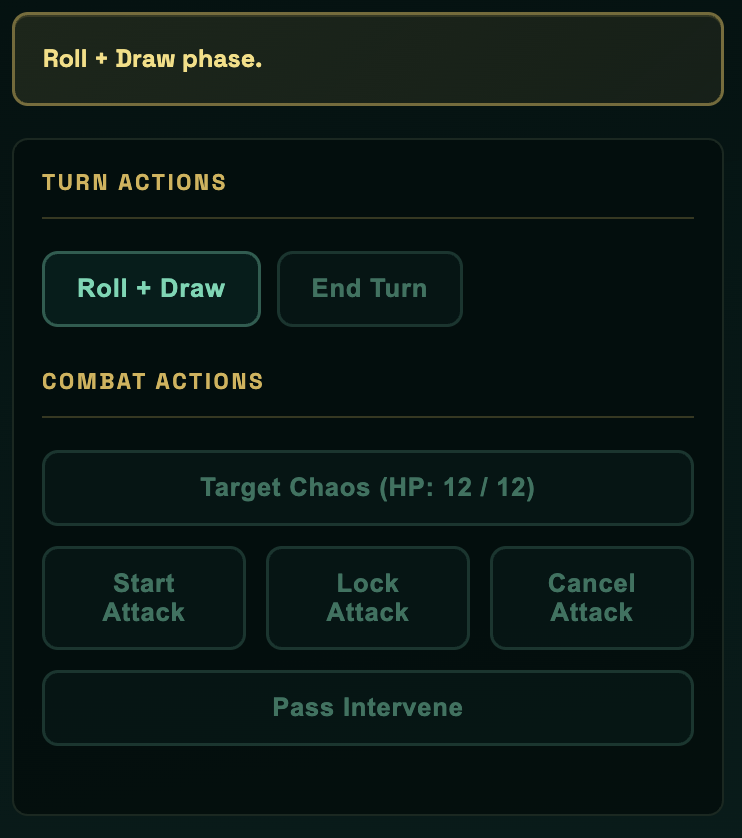
2. Roll + Draw. Click Roll + Draw. You roll 1-6 and draw the top card from that deck (1=Buildings, 2=Spells, 3=Creatures, 4=Artifacts, 5=Heroes, 6=Bonuses).3. Play a card. Click any white card in your hand. Targeted cards (Scorch, Missile...) arm first — pick a defender, then click their creature/building/hero. Untargeted cards play immediately.
Walkthrough: Attacking
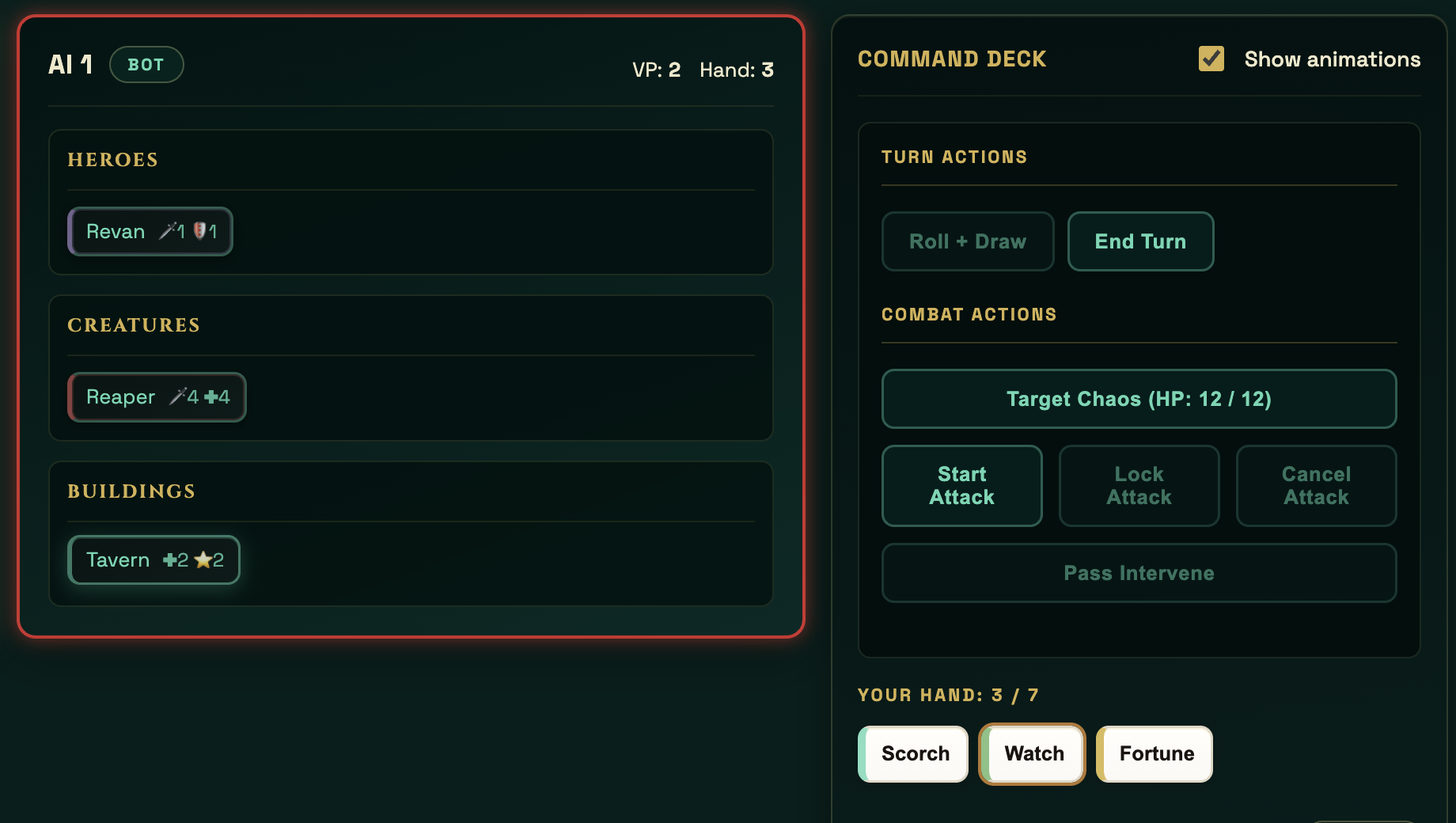
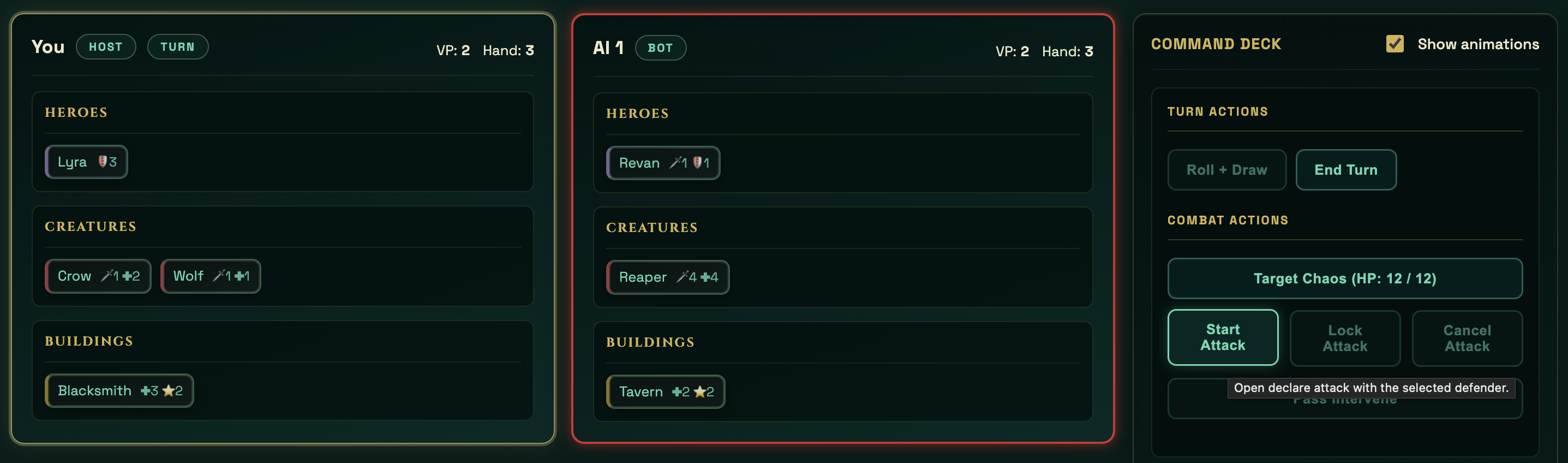
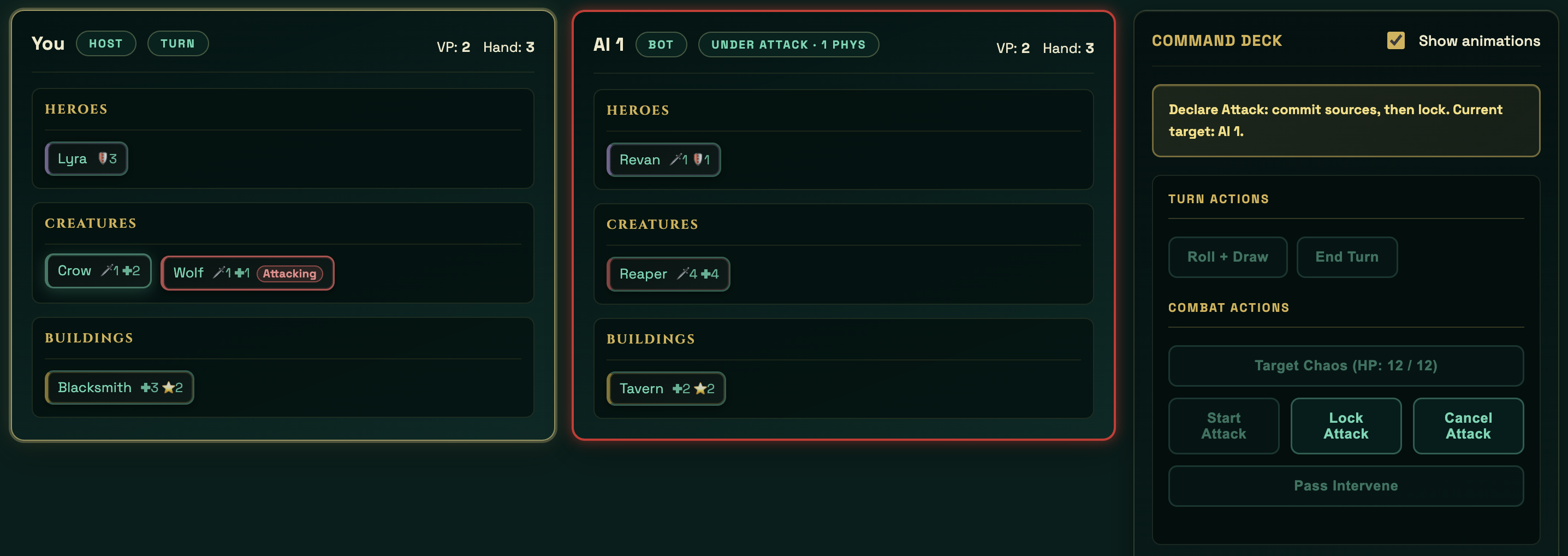
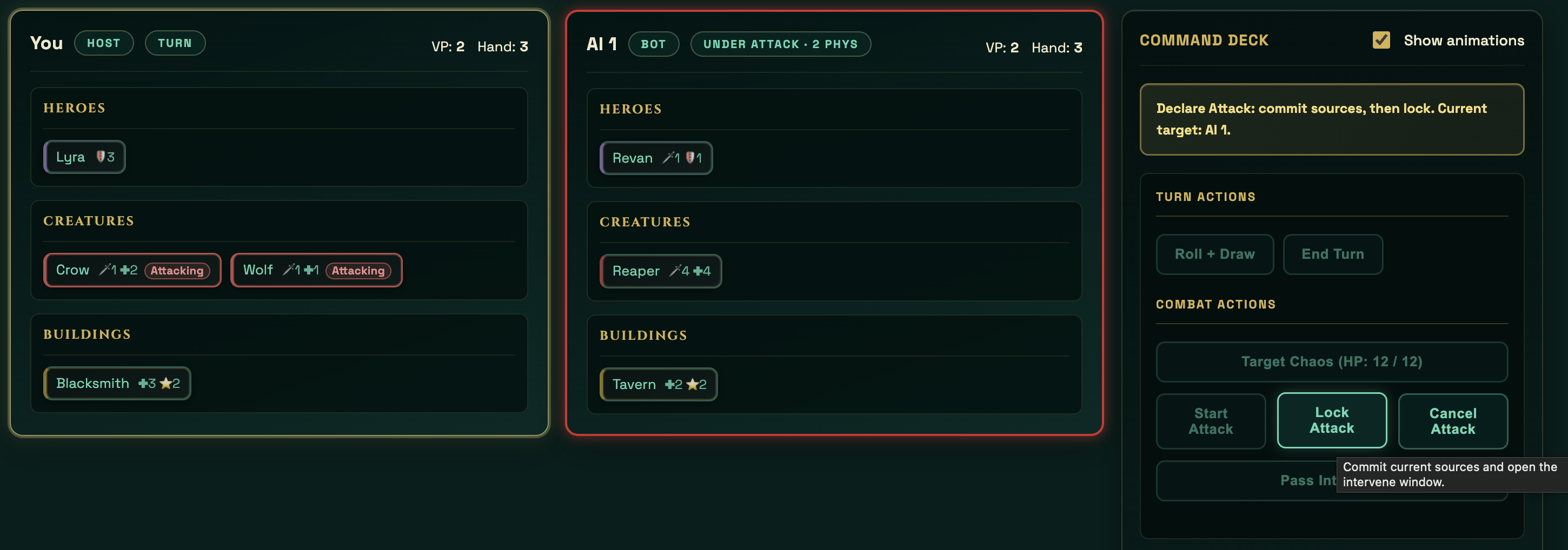
1. Pick a defender. Click another player's name/panel to target them. Use Target Chaos to attack the Chaos deck for chaos rewards.2. Start Attack. Click Start Attack. You're now in Declare Attack: commit your attackers.3. Commit sources. Click each of your creatures and heroes you want to attack with. Spells from your hand can also be added. Selected sources are outlined.4. Lock Attack. Click Lock Attack to commit your damage and open the intervene window. After everyone responds (or passes), damage resolves.
No attackers ready? You can skip combat entirely — just play cards and click End Turn.
Walkthrough: Defending & Intervening
1. Set defense order. When you're targeted, drag your creatures and buildings to reorder them — damage hits the leftmost first. Heroes always absorb physical damage first, automatically, up to their shield value; you don't reorder them.2. Intervene. While the intervene window is open you can play an Artifact card to react — Bubble to protect a card, Mirror to reflect a spell, Staff to cancel a spell, etc. Or click Pass Intervene.
Healing: Any damage left on your board after combat heals back to full at the end of your turn — so a creature that survived an attack will be fresh again before your next turn.
Watchout: Offering a gift on your turn locks you out of intervening for the rest of the round.
Card Types at a Glance
Buildings (Deck 1): permanent boosts and the Shed win path.
Spells (Deck 2): direct damage or attack-source damage.
Creatures (Deck 3): your attackers and front line.